
While I was in grade school, one of my favorite activities was laboratory sessions. I loved forming hypothesis, testing them through experimentation, and analyzing all of the gathered data for a final lab report. At the same time, hidden away in all my notebooks were doodles I’d scribble during lectures using pens and highlighters. Being a simultaneously analytical and creative person, it comes as no surprise that UX design is my ideal career path. In this post, I explore exactly how UX design challenges both the logical and artistic hemispheres of my brain.
UX DESIGN AS A SCIENCE
A major component of UX design consists of collecting input from users, conducting research, and using those results to formulate informed, actionable design decisions. By all accounts, these steps already qualify as scientific methodology. According to Joel Marsh of The Hipper Element, “Scientific theories are a matter of constructing models through experimentation, which then predict future experimental results. By this definition, UX is a science, not an art.” However, I do not agree with his statement entirely, as UX design requires some acumen when it comes to discerning visually pleasing interfaces. This is exactly why research techniques such as competitive analysis and heuristic evaluation exist. Being able to ascertain whether an interface will fulfill user needs both functionally and visually is important for a UX designer.
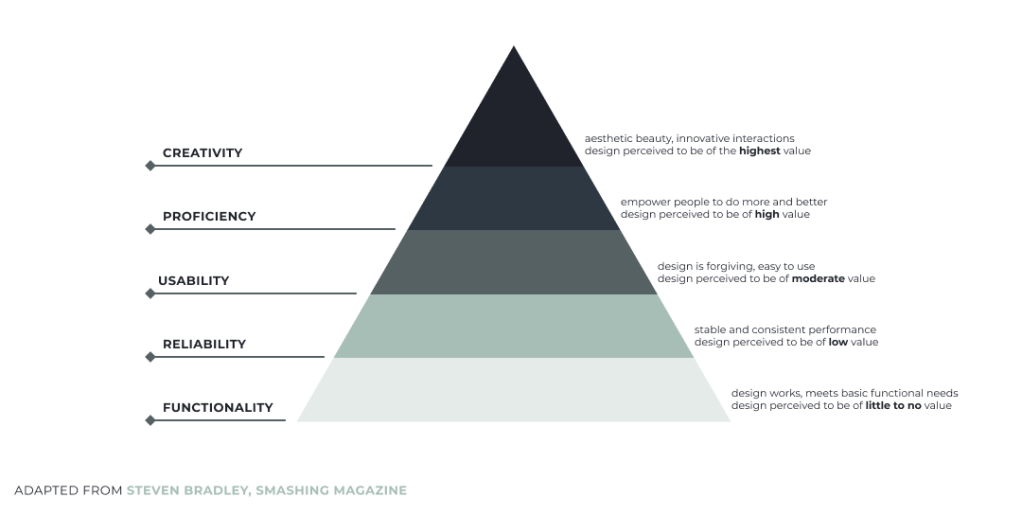
In addition, just as Maslow’s Hierarchy of Needs exists, a Design Hierarchy of Needs has also been established by Steven Bradley in 2010, further cementing the principle that UX design follows scientific principles (similar to psychology). In this hierarchy, a design must meet the basic requirements at the bottom of the pyramid before moving on up the tiers. Fulfilling the creativity requirement is considered the highest tier, thus incorporating it into design work allows the interface to have highest value.
UX DESIGN AS AN ART
At the other end of the spectrum, UX design also allows for creativity and innovation (also evidenced in the aforementioned Design Hierarchy of Needs). According to Bootcamp contributor Ankush Arora, “Artistic elements add depth, personality, and emotional resonance to the user experience, making it more memorable and enjoyable.” Ankush further details how UX design and art intersect harmoniously:
- Creating visual delight. UX designers can use color theory, composition principles, typography, iconography, and imagery to create aesthetically pleasing interfaces. Doing so has the ability to evoke positive emotions and reactions from users, enabling better user experience holistically. This will in turn increase user engagement, another bonus!
- Fostering emotional connections. It goes without saying that art and human emotion are intrinsically connected. UX designers can tap into this interconnection by infusing their designs with artistic elements such as illustrations, animations, and micro-interactions. Adding these elements can elicit a sense of trust, empathy, and overall delight amongst users.
- Pushing boundaries and innovation. By leveraging more creativity in their design work, UX designers can think outside the box and experiment with non-traditional elements. This allows their designs and the user experiences they deliver to stand out from the crowd. When designers break such boundaries, the UX field can grow and evolve in general.
- Encouraging and establishing the importance of collaboration. Since UX designers work with many different factions of professionals – stakeholders, developers, researchers, content strategists – it is vital to acknowledge the cruciality of collaboration. Working together with such diversity enriches the entire design process and promotes sufficient balance between functionality and visual appeal.
FINAL THOUGHTS
I’ve always appreciated both research and art throughout my life, and finding a career that combines both has been revolutionary. The fusion of logic and creativity found in UX design perfectly engages both hemispheres of my brain. Exploring exactly how it does so within this post, and discovering how UX follows a scientific formula while also incorporating artistic flair was a deeply educational (and also validating) experience.
Would you consider yourself a more creative person, a more logical person, or a bit of both like myself? Please feel free to share your thoughts in the comments down below!
 Neha Pasnoori | Blog
Leave a comment